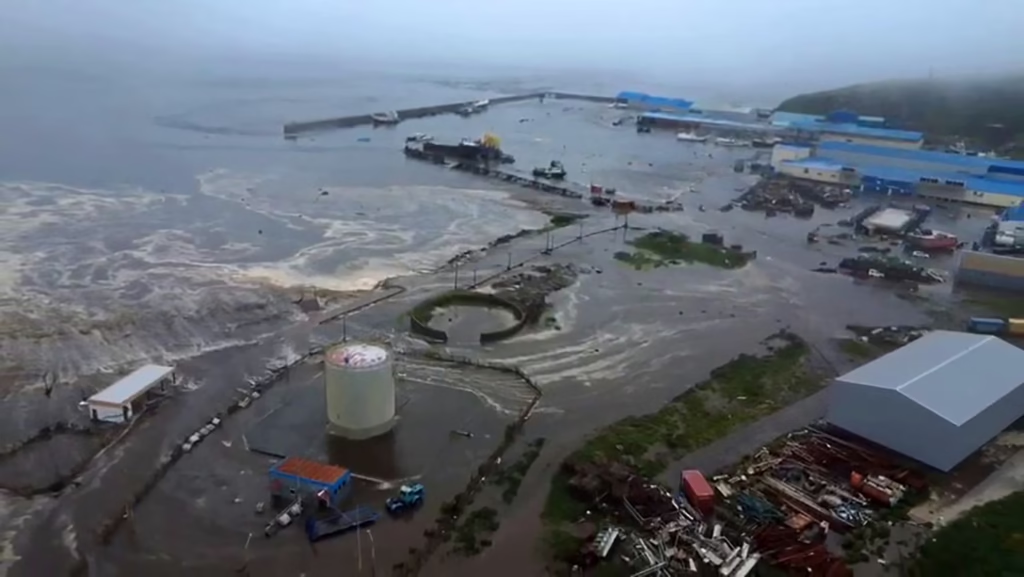
🌊 Unstoppable Forces: A Comprehensive Guide to Tsunamis and Their Global Impact
Meta Description:
Tsunami – a powerful natural disaster triggered by earthquakes or landslides under the sea. Discover the science, history, and safety strategies behind these giant waves in this in-depth 3000+ word guide on tsunamis.
1. What Is a Tsunami? Definition and Origins
A tsunami is a series of large sea waves caused by a sudden and powerful disturbance, typically originating from underwater earthquakes, volcanic eruptions, or landslides. Contrary to the calm waves seen on beaches, tsunamis move rapidly across oceans and can rise to devastating heights as they approach coastal regions.
The word tsunami comes from the Japanese words “tsu” (harbor) and “nami” (wave), literally translating to “harbor wave.” While the name may sound tranquil, the reality is anything but. Tsunamis are nature’s bulldozers — massive walls of water that can obliterate entire communities in minutes.
These waves can travel across oceans at speeds of up to 800 kilometers per hour (about 500 miles per hour), losing very little energy. When they reach shallower waters near the coast, their speed decreases, but the wave height dramatically increases — sometimes up to 30 meters (about 100 feet) or more.
2. The Science Behind Tsunamis: How They Form
Understanding how tsunamis form requires a look at the earth’s geological processes. While various events can trigger a tsunami, most are caused by seismic activity beneath the ocean floor.
2.1 Earthquakes and Undersea Plate Movement
The Earth’s crust is made up of tectonic plates that are constantly shifting. When two plates grind against each other, pressure builds up over time. Eventually, this pressure is released as an earthquake. If the earthquake occurs underwater, the abrupt movement can displace a massive volume of water, initiating a tsunami.
The most tsunamigenic earthquakes occur in subduction zones, where one plate is forced beneath another. This sudden vertical motion lifts the overlying water column and sends out waves in all directions.
Key Statistics:
- Around 80% of tsunamis are triggered by undersea earthquakes.
- The 2011 Japan tsunami was caused by a magnitude 9.0 quake — one of the most powerful in recorded history.
2.2 Landslides and Volcanic Activity
Although less common, underwater landslides and volcanic eruptions can also trigger tsunamis. When large masses of earth or volcanic material rapidly fall into the ocean, they displace water much like a hand slapped into a bathtub.
A notable example is the 1883 Krakatoa eruption, which led to colossal waves and killed over 36,000 people in Indonesia. Submarine landslides following coastal erosion or earthquakes can also initiate tsunamis with little or no warning.
3. Historical Tsunamis: Disasters That Shaped the World
The impact of tsunamis has been both catastrophic and transformational. These events have changed landscapes, reshaped coastlines, and altered the course of history in some regions.
3.1 The 2004 Indian Ocean Tsunami
One of the most devastating natural disasters in modern history occurred on December 26, 2004, when a 9.1 magnitude earthquake struck off the coast of Sumatra, Indonesia. The resulting tsunami affected 14 countries, including Thailand, Sri Lanka, India, and Somalia.
Toll of the Disaster:
- Over 230,000 deaths
- More than 1.7 million people displaced
- Caused over $15 billion in damages
This tragedy also led to international reforms and improvements in tsunami early warning systems, especially in the Indian Ocean region, which previously lacked such infrastructure.
3.2 Japan’s 2011 Tōhoku Tsunami
On March 11, 2011, Japan experienced one of its most significant natural disasters. Triggered by a magnitude 9.0 earthquake off its northeastern coast, the tsunami waves reached heights of up to 40.5 meters (133 feet) in some areas.
Key Impacts:
- Nearly 20,000 people killed or missing
- Led to the Fukushima Daiichi nuclear disaster
- Over $235 billion in damages — the costliest natural disaster ever recorded
Japan’s preparedness, including its early warning systems and tsunami barriers, saved countless lives. However, the scale of the event showed the need for even more resilient infrastructures.
✅ FAQs: Common Questions About Tsunamis
Q1: Can animals sense tsunamis before they strike?
A: Yes. Many animals seem to detect seismic vibrations or pressure changes in the earth. In the 2004 tsunami, numerous elephants, dogs, and birds moved to higher ground before humans noticed danger.
Q2: Are tsunamis always caused by earthquakes?
A: No. While earthquakes are the most common trigger, landslides, volcanic eruptions, and even asteroid impacts can generate tsunamis.
Q3: How fast can a tsunami travel?
A: In deep water, tsunamis can travel as fast as 500–800 km/h (310–500 mph). That’s nearly as fast as a jetliner.
Q4: Can we predict a tsunami in advance?
A: We can detect potential triggers like underwater earthquakes, but we can’t predict tsunamis in the same way we forecast weather. However, early warning systems greatly reduce risk.
Q5: What’s the difference between a tidal wave and a tsunami?
A: Tidal waves are caused by gravitational interactions between Earth, the moon, and the sun. Tsunamis are caused by sudden movements like earthquakes or landslides.
Q6: Is it safe to go back after the first wave?
A: No! Tsunamis often consist of multiple waves, sometimes hours apart. The second or third wave can be more destructive than the first.